
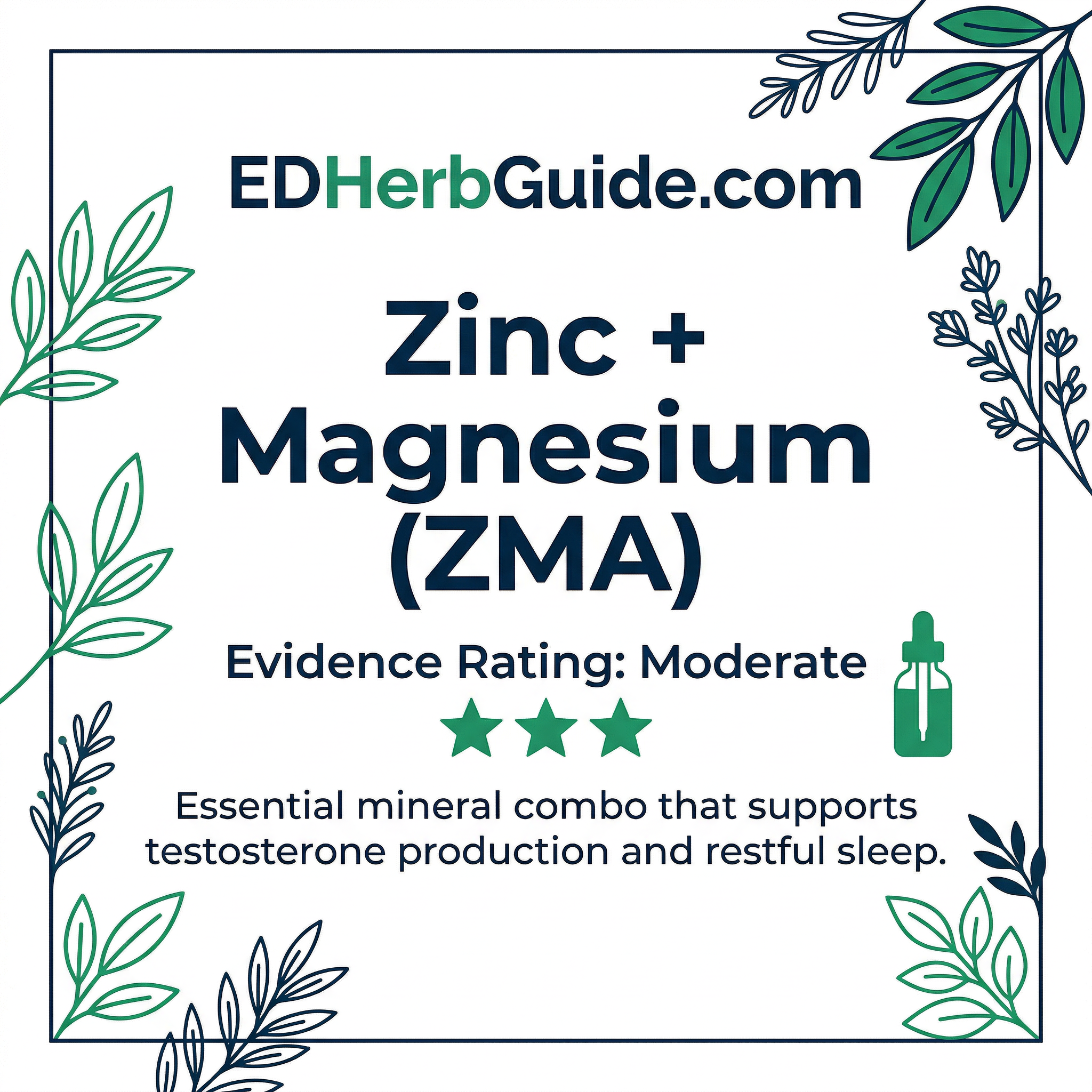
Herb Profile · Moderate Evidence
Zinc & Magnesium (ZMA) for Erectile Dysfunction
Before spending money on exotic herbs, check your foundation. Zinc and magnesium deficiencies are remarkably common in men with low testosterone and ED — and fixing a deficiency can produce results nothing else will.
Our Verdict
Zinc and magnesium are not glamorous. They don't have a 2,000-year legend or a Viagra-like mechanism. What they have is this — if you are deficient in either mineral, no other supplement on this list will work as well as it should. Correcting a nutritional deficiency is the most reliable intervention in natural health. Start here before layering in anything else.

Recommended Product
ZMA — Zinc Picolinate + Magnesium Glycinate + B6
Look for picolinate and glycinate forms specifically. Avoid oxide forms — they are poorly absorbed and a waste of money.
Typically $15–$25 for 60-day supply
Affiliate link · We may earn a small commission
Urologist's Foreword
Want the complete picture on ED?
Jay Richard’s books on erectile dysfunction feature a foreword by a board-certified urologist and cover the full landscape — what causes ED, what natural approaches can and can’t do, and when professional treatment makes sense. Honest. Direct. Written for men who want real answers.
Why minerals and ED?
Zinc and magnesium are two of the most important minerals for male hormonal health — and two of the most commonly depleted in modern men. The connection to ED is direct: both minerals play essential roles in testosterone production, and low testosterone is one of the most common underlying contributors to erectile dysfunction.
The problem is that most men have no idea they are deficient. Standard blood panels often don’t include these markers, and the symptoms of deficiency — fatigue, reduced libido, poor sleep, difficulty maintaining muscle — overlap with so many other conditions that the mineral connection gets missed entirely.
Not sure where to start?
Take our free 2-minute quiz to get a personalized recommendation based on your symptoms and situation.
How common is deficiency?
Research estimates that up to 45% of older American men have inadequate zinc intake, and magnesium deficiency is considered one of the most widespread nutritional shortfalls in the developed world — affecting an estimated 48% of Americans. Heavy exercise, stress, alcohol consumption, and certain medications all accelerate depletion of both minerals. If you are over 40, active, drink alcohol regularly, or take a proton pump inhibitor (heartburn medication), the odds of suboptimal levels are high.
What each mineral does
Zinc — the testosterone mineral
- Required for testosterone synthesis in the Leydig cells of the testes
- Inhibits aromatase — the enzyme that converts testosterone to estrogen
- Essential for sperm production and prostate health
- Supports healthy immune function and wound healing
Magnesium — the sleep and stress mineral
- Required for over 300 enzymatic reactions including hormone production
- Regulates cortisol and the stress response
- Supports deep sleep — the primary window for testosterone production
- Helps maintain healthy blood pressure and vascular function
What does the research say?
The research on zinc, magnesium, and testosterone is some of the most consistent in nutritional science — particularly for men who are deficient to begin with.
Nutrition — Zinc and Testosterone in Athletes
Wrestlers with exercise-induced zinc depletion were supplemented with zinc for four weeks. Testosterone levels and thyroid hormones were measured before and after supplementation and compared to a non-supplemented control group.
Result: Zinc supplementation prevented the exercise-induced drop in testosterone and thyroid hormones, maintaining levels significantly above the unsupplemented control group. Confirms zinc’s direct role in testosterone maintenance.
Journal of Exercise Physiology — ZMA and Testosterone
27 NCAA football players were given ZMA (zinc, magnesium, and vitamin B6) or placebo nightly for eight weeks during spring training. Testosterone, IGF-1, and muscle strength were measured throughout.
Result: The ZMA group showed significantly higher free testosterone levels and IGF-1 compared to placebo, along with greater gains in muscle strength — suggesting meaningful hormonal optimization from mineral repletion alone.
Biological Trace Element Research — Magnesium and Free Testosterone
399 men aged 65 and older were evaluated for magnesium levels and free testosterone. Researchers examined whether magnesium status predicted testosterone independently of other variables including physical activity.
Result: Magnesium levels were positively and independently associated with free testosterone levels — even after adjusting for age, physical activity, and other confounding factors. Low magnesium predicted low testosterone.
How does it work?
Zinc works directly in testosterone biosynthesis — it is a required cofactor for the enzymes that produce testosterone in the testes. It also inhibits aromatase, the enzyme that converts testosterone into estrogen, helping maintain the testosterone-to-estrogen balance that declines in many men with age.
Magnesium works more indirectly but just as importantly. It binds to sex hormone binding globulin (SHBG), a protein that locks testosterone in an unusable form. When magnesium is adequate, less testosterone gets bound by SHBG — meaning more of the testosterone you produce is actually free and available for your body to use. Magnesium also supports the deep sleep stages when the majority of daily testosterone production occurs.
Dosage Guide
| Mineral | Daily Dose | Best Form | Timing |
| Zinc | 25–45mg | Zinc picolinate or bisglycinate | With food to avoid nausea |
| Magnesium | 300–400mg | Magnesium glycinate or malate | Evening — supports sleep |
| ZMA (combined) | Per label | Zinc + Magnesium + B6 | 30–60 min before bed |
Dosage note: Form matters significantly with both minerals. Zinc oxide and magnesium oxide are cheap and poorly absorbed — found in many low-cost multivitamins. Zinc picolinate and magnesium glycinate are the most bioavailable forms and worth the modest price difference. If buying a combined ZMA product, check that it uses these better-absorbed forms.
Safety notes
Zinc is very safe at recommended doses but can cause nausea if taken on an empty stomach — always take with food. Long-term high-dose zinc (above 40mg daily) can deplete copper, so avoid exceeding the recommended dose without medical supervision. Magnesium glycinate is extremely well tolerated. Magnesium oxide can cause loose stools at higher doses — another reason to use the glycinate form. Neither mineral interacts significantly with most medications at normal supplemental doses.
A complete natural approach — building from the foundation up
- Layer 1 — Foundation: Zinc + Magnesium (ZMA). Correct any deficiency first. Everything else works better on a solid nutritional base.
- Layer 2 — Blood flow: Korean Red Ginseng and/or L-Arginine. Address the vascular mechanics of erectile function.
- Layer 3 — Stress and hormones: Ashwagandha KSM-66. Manage cortisol and support sustained testosterone levels.
- Layer 4 — Desire: Maca Root. Reignite libido and sexual motivation independently of the physical mechanics.
- Optional addition: Horny Goat Weed (icariin). Adds a complementary PDE5-inhibiting mechanism for men who want to address the pathway from multiple angles.
Not sure where to start?
Take our free 2-minute quiz to get a personalized recommendation based on your symptoms and situation.
The Bottom Line
Zinc and magnesium are the unglamorous heroes of the natural ED toolkit. No legend, no dramatic mechanism story — just essential minerals that a surprising number of men are short on, with a direct and well-documented impact on testosterone and sexual function. If you do nothing else on this site, get your zinc and magnesium right. Then build from there.
The information on this page is for educational purposes only and does not constitute medical advice. Studies referenced are summarized for general understanding — always read original research and consult a qualified healthcare provider before starting any supplement, particularly if you take prescription medications or have thyroid, autoimmune, or other chronic health conditions.